Table of Contents
Hyundai Aiming for a Sixth Consecutive Year of Record Sales
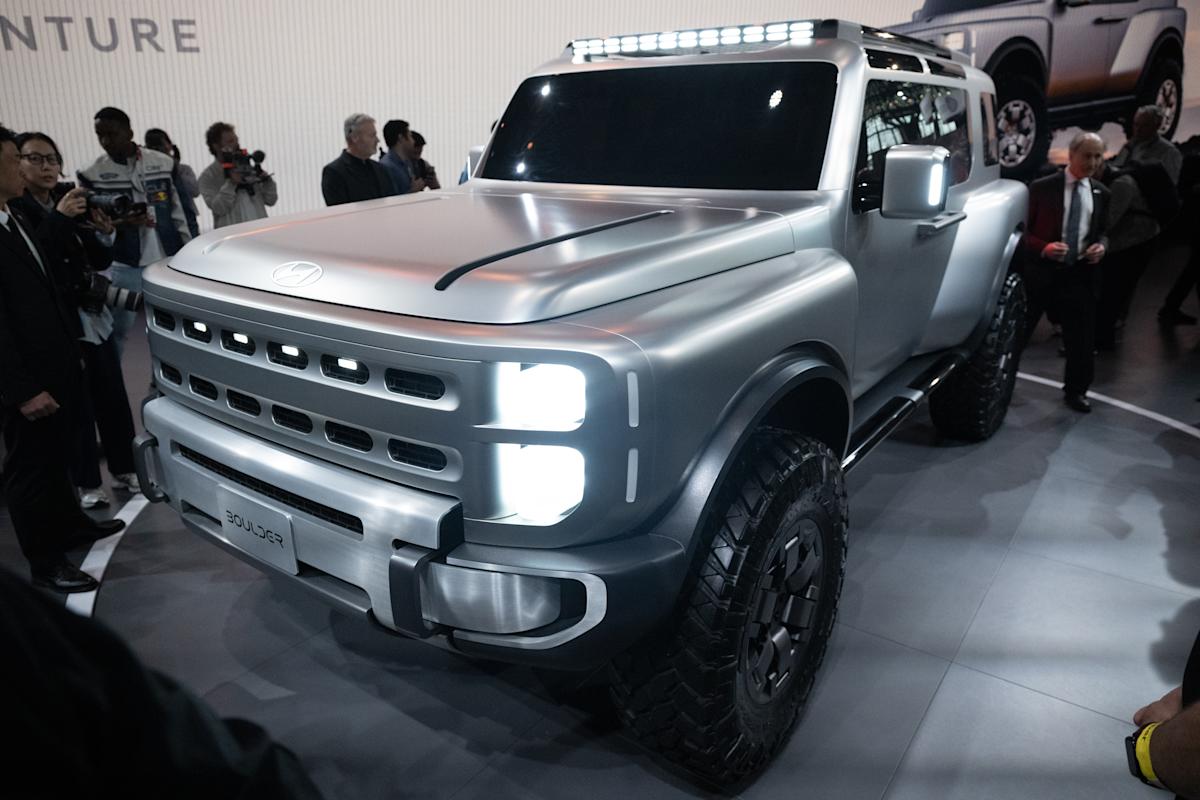
At the New York International Auto Show, Hyundai North America CEO Randy Parker ambitiously declared his intention for the company to achieve “six for six” — a sixth consecutive year of record retail sales in the U.S. This optimism rests on the unveiling of the Boulder concept, a robust body-on-frame SUV featuring impressive 37-inch off-road tires and a design philosophy termed "Art of Steel." This reveal marks a significant shift for Hyundai, a brand traditionally linked with practical sedans and crossovers, showcasing a new direction aimed at capturing a broader market segment.
The Boulder concept, which bears a resemblance to the Ford Bronco, is not just about aesthetics; it highlights Hyundai’s plans to elevate its presence in the body-on-frame segment — a territory largely claimed by Ford, GM, and Stellantis’ Ram. Parker acknowledged customer demand as a driving factor for this new venture, stating, “The customers are telling us they want more,” reinforcing the need for diverse offerings.
To kickstart this new chapter, Hyundai plans to launch a midsize pickup truck by 2030, manufactured in the U.S. using steel sourced from a new facility in Louisiana. This initiative is part of a broader strategy that entails releasing 36 new models in North America over the next decade.
Navigating Challenges in the Automotive Market
Despite the promising outlook, Parker admitted that entering the body-on-frame market comes with its own set of challenges. The automotive industry grapples with tariffs, rising affordability concerns, and an unstable supply chain. Parker’s strategy for overcoming these obstacles is centred on localisation, aiming for at least 80% of production to occur in North America by 2030.
Hyundai’s Metaplant America, situated in Savannah, Georgia, represents a significant investment of $12.6 billion, with the first phase designed to produce 300,000 vehicles annually, ramping up to 500,000 in phase two by 2030. The facility aims to create approximately 8,700 jobs, further cementing Hyundai’s commitment to the U.S. market.
“The best way to alleviate tariffs is to localise production,” Parker emphasised, highlighting the importance of adapting to the changing economic landscape. Currently, the Georgia plant focuses on electric vehicles, including the IONIQ 5, which has seen a substantial sales increase year-on-year in Q1, despite the removal of federal EV tax credits. As part of its multi-powertrain strategy, Hyundai is also gearing up to include hybrid models in the facility’s production.
Meeting Customer Needs in a Changing Market
Parker reiterated the company’s objective to cater to varying customer preferences in their journey towards electrification. “We want to meet the customer on their journey to electrification,” he stated, indicating that Hyundai aims to accommodate consumers who may opt for hybrids before making a full transition to electric vehicles.
With the Boulder concept generating considerable excitement, Hyundai appears poised to achieve its goal of a sixth consecutive year of record sales. Nevertheless, the South Korean automaker must adeptly navigate the complexities posed by fluctuating trade policies and the financial pressures affecting U.S. consumers.
In summary, as Hyundai embarks on this new era characterised by innovative vehicles and localised production, the company’s adaptability will be crucial in influencing its success amidst the prevailing economic uncertainties.