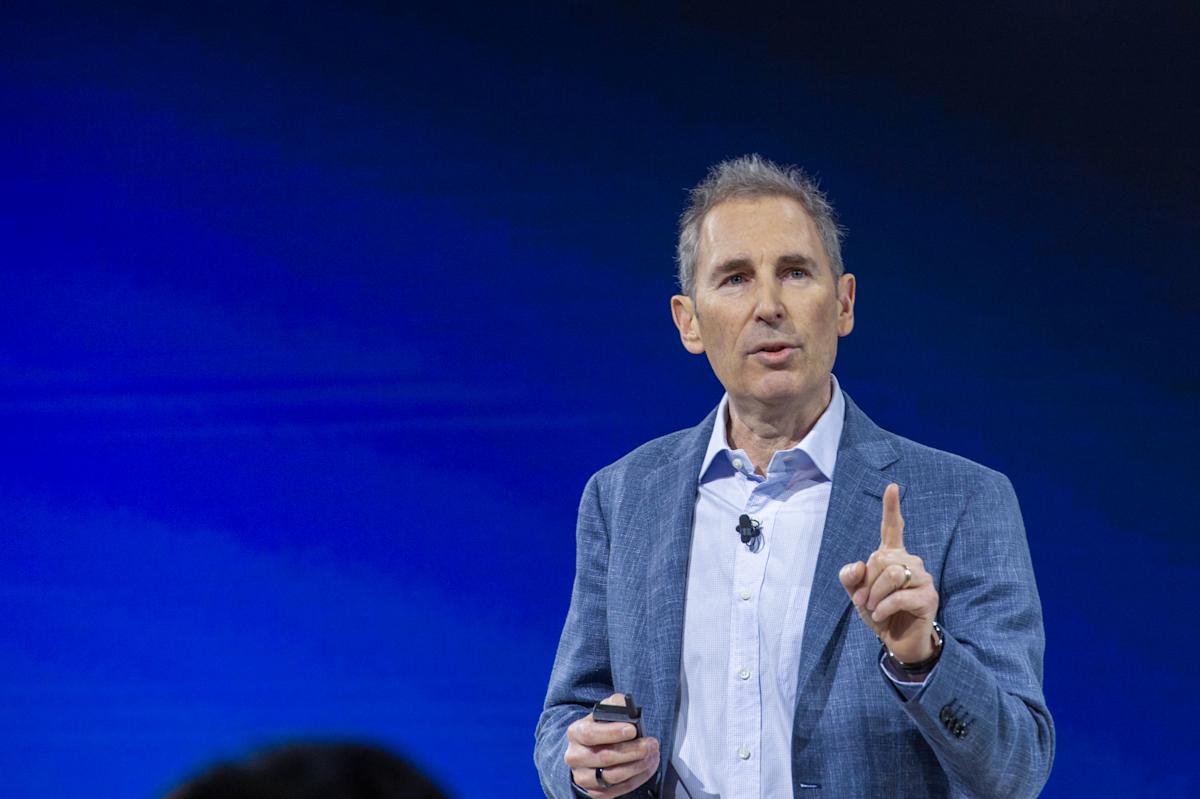
In his annual shareholder newsletter released on Thursday, Amazon (AMZN) CEO Andy Jassy outlined the company’s strategic focus on artificial intelligence (AI) and hinted at the potential to sell AI processors to third parties, thereby intensifying competition against Nvidia (NVDA) and AMD (AMD).
Jassy expressed confidence in the AI sector, asserting that it is not a bubble but rather an evolving technology with promising profit margins and impressive returns on capital. His optimism is based on the brisk pace of AI adoption and the soaring revenues generated by Amazon Web Services (AWS).
As of the first quarter of 2026, AWS’s AI revenue has exceeded a run rate of $15 billion and is projected to expand further. Jassy noted that growth could be even more rapid; however, the company is facing capacity constraints, despite adding 3.9 gigawatts in 2025 and plans to double this by 2027.
He disclosed that two significant AWS clients had inquired about acquiring all of Amazon’s custom CPU Graviton capacity for 2026, but Jassy declined this request due to the need to maintain service levels for other customers.
Taking a jab at Nvidia, Jassy highlighted that while Amazon continues to utilise its chips, customers have expressed a desire for improved price-performance ratios. This demand underlines the success of Amazon’s Trainium2 AI GPU, which is sold out, whereas the recently launched Trainium3 is nearly fully subscribed.
According to Jassy, developing proprietary chips offers numerous advantages, including cost reduction for clients and enhanced economic performance for AWS. He projected that once scaled, Trainium could save Amazon tens of billions in capital expenditures annually and produce a significant operating margin advantage compared to relying on third-party chips.
Amazon’s chip division currently boasts an annual revenue run rate of around $20 billion, growing at triple-digit rates. However, Jassy noted this is likely an understatement, as the figure only reflects monetisation via AWS’s EC2 service. He further estimated that if treated as a separate entity, Amazon’s chip revenue could reach a staggering run rate of approximately $50 billion.
Jassy also mentioned strong demand for their chips, suggesting a possibility of selling them in racks to third parties in the future.
Amazon’s ambitious investments, however, come at a cost. The company plans to allocate an eye-watering $200 billion in capital expenditures for 2026, which has factored into a 7% decline in stock prices following the announcement.
Beyond AI and chip developments, Jassy delved into Amazon’s robotics initiatives, revealing that over 1 million robots are currently employed in its fulfilment centres. The company is also exploring opportunities to manufacture robots for external clients.
Additionally, he highlighted Amazon’s satellite internet system, ‘Amazon Leo’ (low Earth orbit), which has deployed more than 200 satellites and has aspirations to launch thousands more in the coming years. Jassy indicated that the service is slated for a mid-2026 launch and has already attracted customers, including Delta, JetBlue, and AT&T.
Lastly, he addressed the progress of Amazon’s drone delivery service, Prime Air, stating that the programme has reached a scalable design. The company aims to service communities comprising 30 million customers by year-end and anticipates delivering half a billion packages by the end of the decade.
In summary, Amazon is positioning itself as a formidable player in the AI landscape while expanding its technological capabilities across various domains, including robotics and satellite communications, amidst significant capital investments and market competition.