Decline in U.S. Tariff Revenues: Insights from March 2023 Data
In March 2023, tariff revenues for the United States plummeted to $22.15 billion, marking a continued decrease following President Trump’s reversal on several tariffs and a Supreme Court ruling deeming some tariffs illegal. According to the latest data from the Treasury Department’s monthly statement, this latest figure represents a significant drop from the $26.59 billion collected in February and stands as the fifth consecutive monthly decline. Notably, this total reflects an almost 30% decrease year-on-year since last October when tariff revenue reached its peak of $31.35 billion.

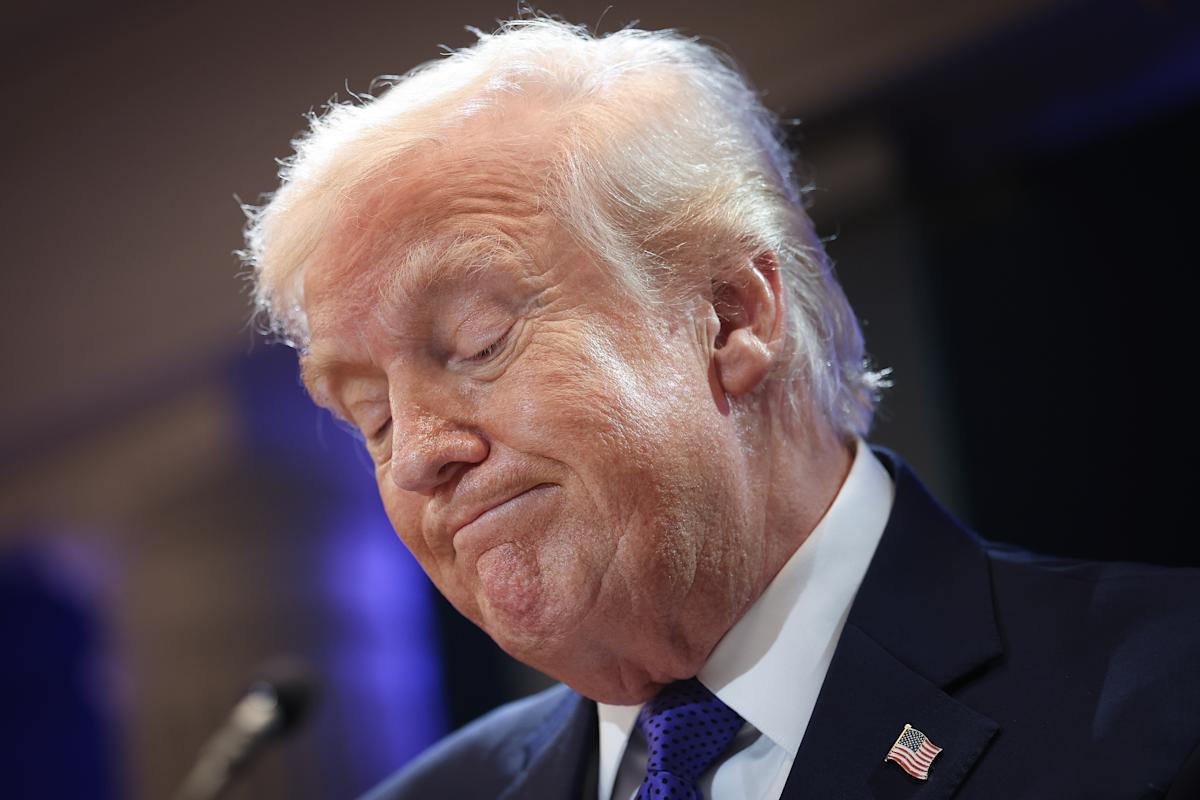
President Trump speaks during a tariff-focused press briefing at the White House on February 20. (Kevin Dietsch/Getty Images)
Budget Deficits Surpass Tariff Revenues
The recent figures also highlighted a budget deficit of $1.169 trillion recorded between October 2022 and March 2023, the first half of the fiscal year. This deficit, which includes $164 billion for March alone, eclipses the tariff revenue generated, countering President Trump’s assertions that tariffs could effectively balance the national budget. Cumulatively, tariffs have yielded around $166 billion for the current fiscal year.
Supreme Court Rulings and New Tariff Strategies
The March data represents the first full month following the Supreme Court’s decision on February 20, which invalidated tariffs previously enforced under the International Emergency Economic Powers Act (IEEPA) of 1977. In response, President Trump announced a new set of global tariffs, imposing a 10% duty for 150 days based on authority from the 1974 Trade Act.
As the administration prepares to refund the invalidated tariffs, a court filing from the previous week indicated that various duties might soon be eligible for refunds, potentially amounting to approximately $166 billion.
The US Court of International Trade in lower Manhattan will oversee the tariff refund process. (Spencer Platt/Getty Images)
Understanding Tariff Refunds and Future Implications
Currently, although some refund processes are in motion, the comprehensive administration of IEEPA refunds has not yet commenced. March’s gross tariff receipts stood at $24.02 billion; however, after accounting for $1.86 billion in refunds, the net revenue fell to $22.15 billion. Refunds are indicative of normal tariff revenue operations as duties are finalised, with a similar amount recorded in January before the court’s ruling.
Concerns surrounding the impact of tariffs have led to a decline in collections, especially as President Trump has been forced to retract tariffs on various items, particularly food products. Recent adjustments to tariffs on metals like steel, aluminium, and copper were also introduced, which could reduce duties on certain products substantially, setting tariffs at 25% on goods significantly composed of these metals.
Conclusion
The ongoing decline in U.S. tariff revenue presents a complex economic challenge, emphasising the intricacies of tariff policy amidst changing judicial landscapes and market conditions. As the government navigates the ensuing fiscal implications and strategies for revenue generation, the ramifications of tariff adjustments and potential refunds remain crucial points for stakeholders in the economic and financial sectors to monitor.