Table of Contents
Gold Steady as US Dollar Weakens: Weekly Gains Near 2%
Gold prices (XAU/USD) have shown resilience on Friday, poised to end the week with a close to 2% increase. This stability comes as the US Dollar declines, fuelled by sentiments surrounding upcoming discussions between the US and Iran in Pakistan this weekend. Despite a slightly elevated US inflation report curbing dovish expectations for the Federal Reserve (Fed) in 2026, the XAU/USD pair is trading at $4,763, reflecting a modest 0.01% gain.
Gold Responds to Optimism Over US-Iran Negotiations
An enhancement in risk appetite has driven gold prices higher, despite ongoing hostilities where Israel continues its attacks on Lebanon, potentially jeopardising the two-week truce brokered by the US and Iran. In a related development, Tehran has not reopened the strategic Strait of Hormuz, a situation President Donald Trump described as "dishonourable."
Negotiations between the US and Iran are set to commence on Saturday, with Iranian representatives participating, even as reports suggest Lebanon’s involvement in the ceasefire agreement.
US Vice President JD Vance is en route to Pakistan, stating, "If the Iranians are willing to negotiate in good faith, we’re certainly willing to extend the open hand. If they’re going to try to play us, then they will find the negotiating team is not that receptive."
US Inflation Data: Fed’s Potential Moves?
Recent data from the US indicated that March inflation aligned with forecasts, as the Consumer Price Index (CPI) rose 3.3% year-on-year, up from 2.4% in February. Meanwhile, core CPI increased slightly from 2.5% to 2.6%, below the expected 2.7%. This has led to investor scepticism regarding any cuts to interest rates by the Federal Reserve, with expectations leaning towards maintaining the fed funds rate within the 3.50%-3.75% range throughout 2026, per Prime Market Terminal (PMT) data.
Additionally, the University of Michigan’s Consumer Sentiment Index plunged to a historic low of 47.6 in April from 53.3, with American households anticipating a rise in inflation to 4.8% in the next year, attributed to the ongoing Middle East conflict driving up fuel prices.
San Francisco Fed President Mary Daly diminished concerns over the CPI results, calling them anticipated, and pointed to the ceasefire as a crucial factor, noting the current policy’s effectiveness in managing inflation while supporting employment.
In parallel, the US Dollar Index (DXY), which measures the currency against a basket of six others, has decreased by 0.13% to 98.66—a near four-week low—favouring gold prices.
Looking ahead, next week’s US economic calendar will include housing data, the Producer Price Index (PPI), employment statistics, and remarks from Fed officials. However, gold investors will be particularly focused on the continuation of US-Iran talks in Pakistan and the potential reopening of the Strait of Hormuz.
XAU/USD Technical Analysis: Resistance at $4,800
Gold prices have shown an upward trend but have struggled to break through significant resistance levels in recent days. The price peaked at $4,857 three days ago but failed to maintain momentum above the critical $4,800 threshold.
Should sellers drive gold beneath $4,750, a slide towards the $4,700 level is anticipated, with the confluence of the 20- and 100-day Simple Moving Averages (SMA) located between $4,674 and $4,662 serving as the next support zone.
On the upside, if gold manages to reclaim $4,800, it would pave the way for a challenge against the April 8 peak of $4,857, with further gains potentially pushing the price above $4,900.
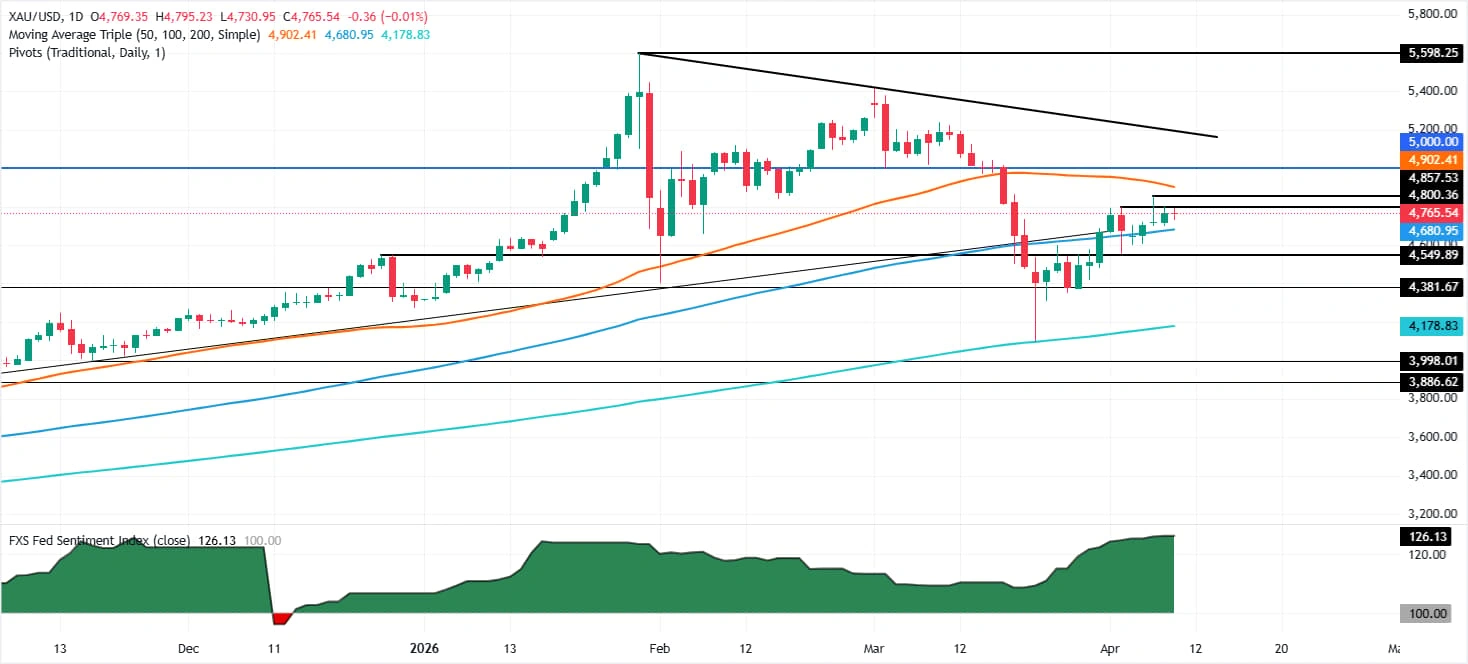
Gold daily chart
Gold FAQs
What role does gold play in history?
Gold has historically served as a store of value and a medium of exchange, renowned for its appeal and use in jewellery. Today, it is perceived as a safe-haven asset during market turbulence and as a hedge against inflation and currency devaluation.
Who holds the most gold?
Central banks are the largest holders of gold, utilising it to strengthen their currencies. In 2022, central banks globally added over 1,136 tonnes of gold worth approximately $70 billion to reserves, marking a historical peak in purchases.
How does gold correlate with the US Dollar?
Gold generally has an inverse relationship with the US Dollar and US Treasuries. A depreciating dollar can lead to rising gold prices, while a strong dollar typically suppresses gold values.
What factors affect gold prices?
Gold prices can rise due to geopolitical instability or fears of economic downturns. As a non-yielding asset, lower interest rates are generally conducive to higher gold prices, whereas higher rates exert downward pressure.
In summary, as market dynamics unfold in response to geopolitical events and economic indicators, the strength of gold as an investment remains a focal area for traders and investors alike.