Table of Contents
Uncertainty Surrounds Digital Asset Market Clarity Act’s Future
Investment bank TD Cowen has revised its forecast regarding the Digital Asset Market Clarity Act, now estimating only a 33% probability that the bill will successfully pass the Senate. Jaret Seiberg, the firm’s managing director, attributes this declining optimism to the recent failure of a bipartisan stablecoin yield compromise, which encountered resistance within the industry, predominantly championed by Coinbase.
Seiberg noted that Coinbase’s stance against yield limits stems from their desire for the broader acceptance of yield-bearing stablecoins. Conversely, banks oppose proposals that might allow tech platforms to offer such yields without adhering to the same regulatory frameworks as traditional deposit accounts.
For the bill to progress, Seiberg argues that Congress may have to disregard the conflicting interests of both Coinbase and the banking sector and reach a compromise to move forward.
Critical Deadlines Loom
The Clarity Act successfully passed the US House of Representatives on July 17, 2025, by a vote of 294 to 134, marking a significant milestone for cryptocurrency legislation. However, the bill has stalled in the Senate, with the core debate focusing on whether stablecoin holders should be permitted to earn interest.
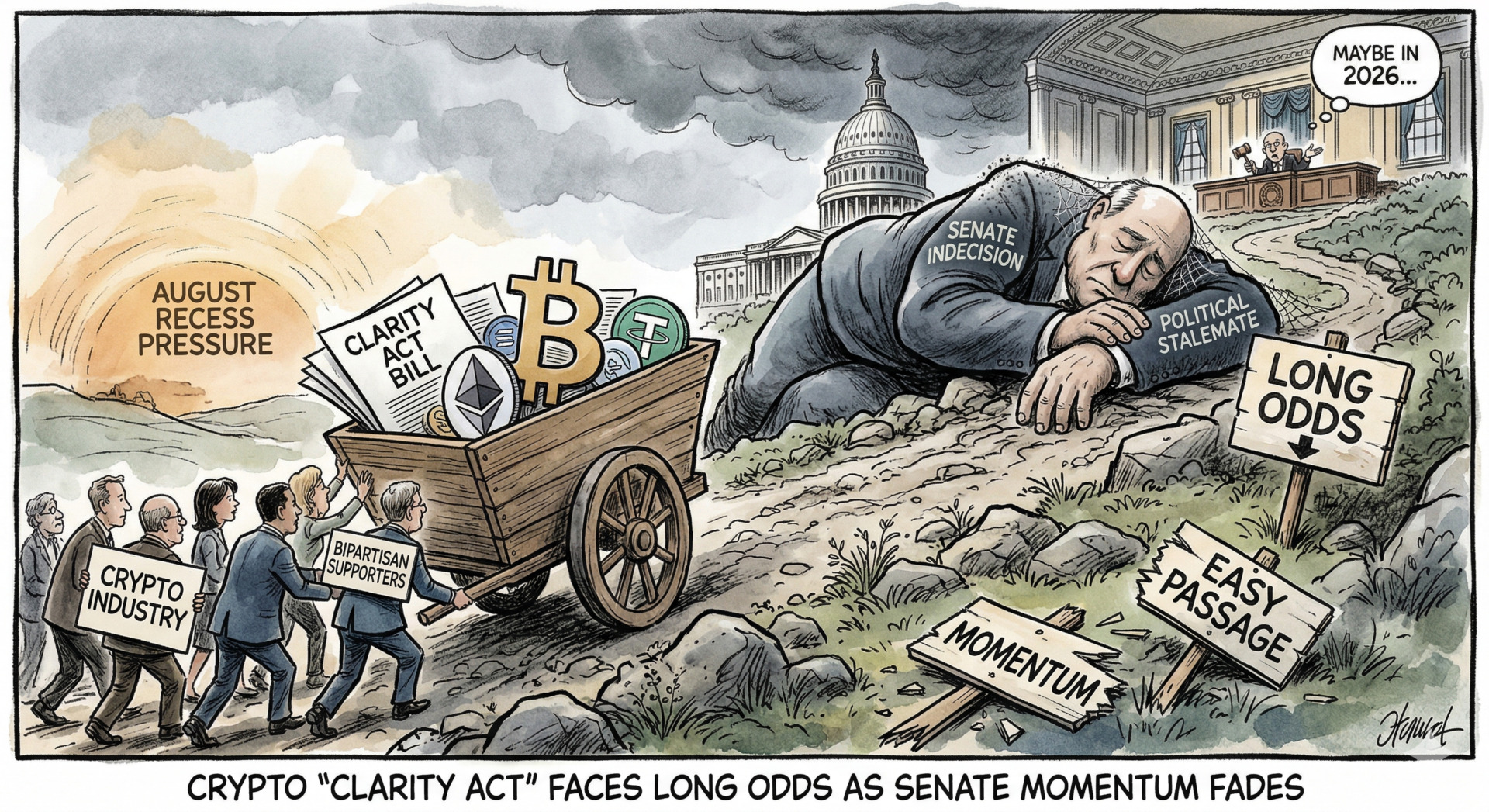
Alex Thorn from Galaxy Digital has highlighted the end of April as a pivotal deadline, warning that failure to clear the Senate committee by this time would severely diminish the chances of the bill’s passage before 2026. This sentiment is reflected in shifting probabilities from prediction market Polymarket, which has recorded a drop in confidence for the bill’s approval from over 70% earlier in the year to just 48% presently.
As the August congressional recess approaches, there is a dwindling window to rectify the bill’s hurdles. TD Cowen has signalled that if the legislation does not advance before the midterm elections—especially should Democrats regain control of any chamber—final approval could be deferred to 2027, pushing any potential implementation to 2029.
This scenario would see the cryptocurrency market continuing to operate without a unified regulatory framework in the US for several more years.
Conclusion
In light of the current political landscape and ongoing negotiations, the outlook for the Digital Asset Market Clarity Act appears increasingly bleak. Industry stakeholders must navigate these critical deadlines and shifting odds if they wish to see a comprehensive regulatory framework established in the near future.