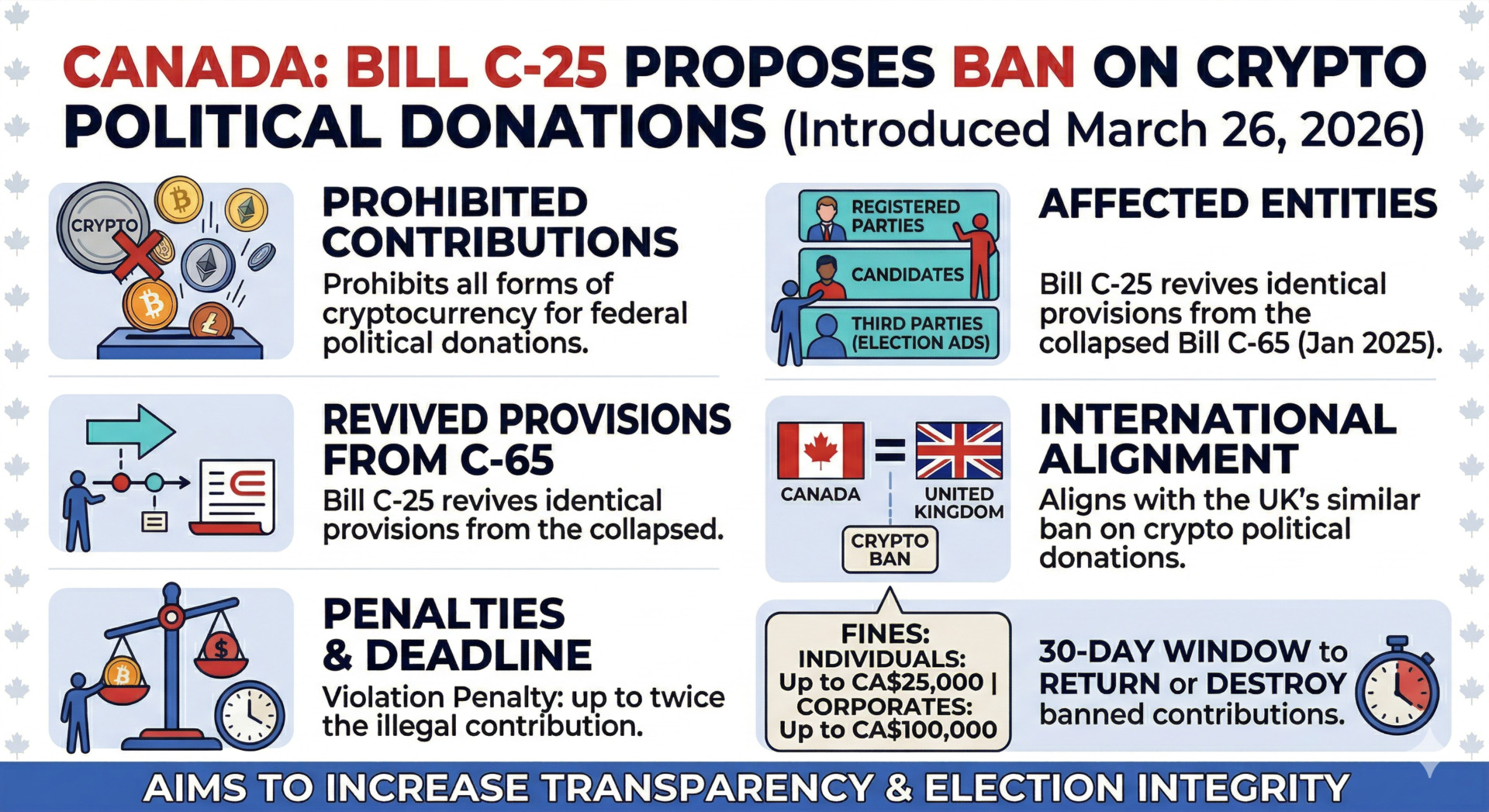
On March 26, 2026, Canada’s Liberal government introduced Bill C-25, which prohibits the use of cryptocurrency for political donations across all registered political parties, candidates, and third-party election advertisers. This legislation aims to eliminate a framework that permitted limited crypto contributions since 2019, wherein non-monitory donations were allowed but primarily restricted to assets on public blockchains. Privacy-centric cryptocurrencies like Monero and Zcash were explicitly excluded from this system.
Under the new bill, any political entity, including parties, local riding associations, and candidates involved in election campaigning, will not be allowed to accept cryptocurrency. Violators of this ban face significant penalties: individual fines can reach CA$25,000 while corporations could incur fines up to CA$100,000. Furthermore, those who receive prohibited contributions will have a 30-day period to either return the funds, destroy them, or convert them and send the proceeds to the Receiver General.
The push for the ban reflects concerns regarding the traceability and security of political donations. Stéphane Perrault, the Chief Electoral Officer, initially sought tighter controls but transitioned to favouring a complete prohibition by 2024. He argued that the pseudo-anonymous characteristics of cryptocurrencies complicate the verification of donors’ identities, leading to potential risks of foreign interference in Canadian elections.
The provisions of Bill C-25 echo similar restrictions previously proposed under Bill C-65, which was abandoned in January 2025 after the prorogation of Parliament following Prime Minister Justin Trudeau’s resignation announcement. This legislative revival aligns with actions taken by the United Kingdom, which has also implemented a ban on political donations via cryptocurrencies.
In addition to addressing the concerns surrounding cryptocurrency, Bill C-25 includes measures combatting foreign interference, bribery, and misleading tactics such as deepfakes, enabling stronger investigative powers for the Commissioner of Canada Elections.
Despite the tightening of regulations and the apparent shift in public policy, cryptocurrencies have not significantly impacted federal political fundraising in Canada, with reports indicating that no major political party disclosed a single crypto donation during the 2021 or 2025 elections.
This legislative move marks a substantial step in Canada’s political framework, aiming to enhance the integrity of political financing and prevent potential misuse of digital assets in electoral processes.