Table of Contents
Big Tech’s Growing Influence in Formula One: Intel Partners with McLaren Racing
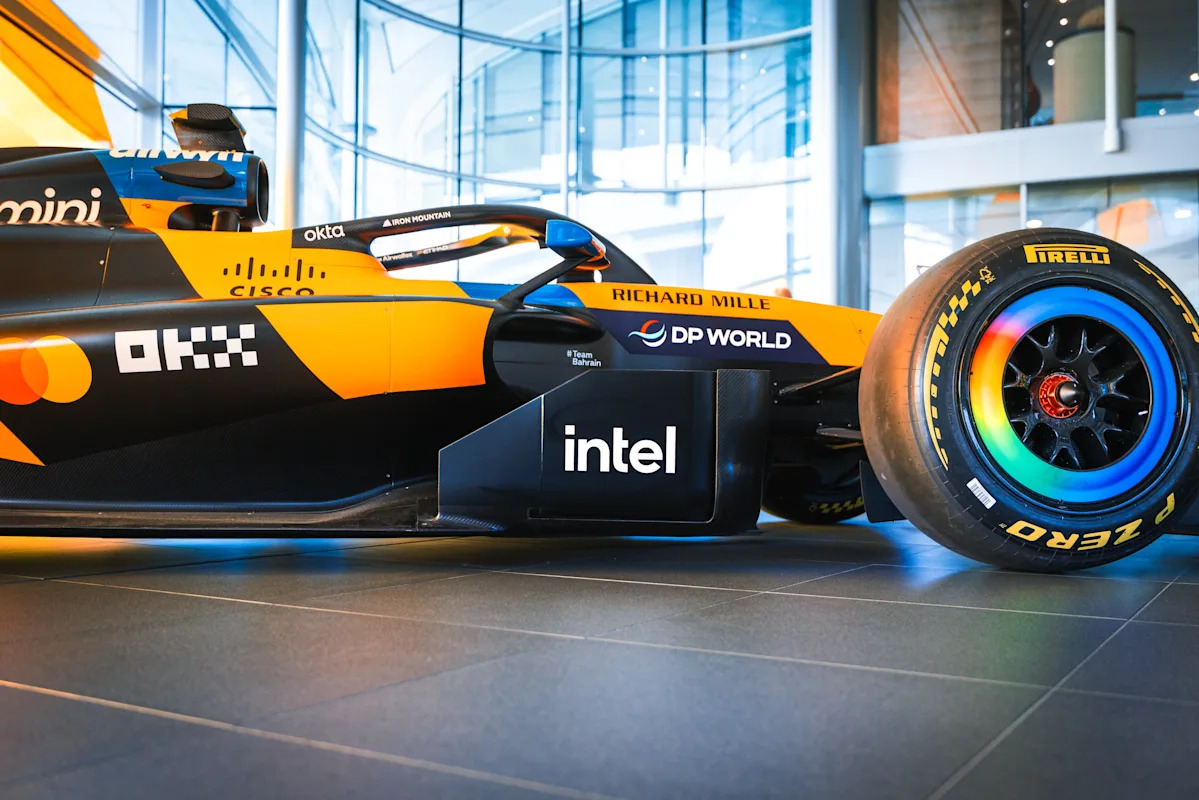
The integration of Big Tech into the world of Formula One (F1) isn’t new, but a recent development has taken it a step further—it’s now extending into the semiconductor sector. Intel (INTC), a prominent chip manufacturer, has solidified its commitment to F1 by forging a partnership with the McLaren F1 racing team, as well as its IndyCar and eSports divisions.
Strategic Collaboration with McLaren
On Thursday, Intel announced its multi-year agreement, which designates the company as the Official Compute Partner for McLaren. This partnership aims to harness Intel’s Xeon and Core Ultra processors to support McLaren’s essential computational tasks, which include:
- Computational fluid dynamics
- Aerodynamic analysis
- Vehicle dynamics simulation
- Race strategy analytics
- Real-time decision-making systems that link McLaren’s headquarters in Woking, England, with its race team
Intel’s CEO, Lip-Bu Tan, expressed enthusiasm for the collaboration, noting that F1 racing serves as a premier testing ground for high-performance computing.
McLaren Racing’s Perspective
Zak Brown, CEO of McLaren Racing, emphasised the historical significance of Intel within their tech framework, asserting that Intel’s leadership in computing will significantly influence car design, engineering, and racing strategies.
The Broader Tech Landscape in F1
Big Tech firms such as Oracle (ORCL), Dell (DELL), Amazon (AMZN), IBM (IBM), Microsoft (MSFT), and more have prominently featured in the F1 landscape, with their branding visible on the cars and at various tracks. Even Apple (AAPL) has established a presence by holding streaming rights for F1 in the US. The rapid evolution of data collection and analysis in F1, coupled with the need for powerful computing resources, positions these companies perfectly to demonstrate their capabilities in real-time scenarios on a global stage.
Chipmakers Enter the Fast Lane
With chipmakers experiencing a surge in their stock values, partly due to heightened interest from investors and government support (notably from the US government’s stake in Intel), the move to form strategic partnerships in F1 is both timely and advantageous.
Intel’s competitor, AMD (AMD), previously partnered with Scuderia Ferrari but transitioned to working with the Mercedes F1 team in 2020. Mercedes highlighted AMD’s importance in optimising aerodynamics and data-driven applications, further showcasing the vital role of chips in competitive racing.
Meanwhile, Ferrari, aligned with Qualcomm (QCOM) for road car technologies, is navigating its chips partnership landscape, recently shifting some focus to Mercedes as well. Notably, the Maranello marque still enjoys significant support from HP (HPQ) and IBM as lead sponsors.
Conclusion
The intersection of technology and motorsport is becoming increasingly pronounced, with chip companies now playing a pivotal role in enhancing performance on the racetrack. As F1 continues to grow in complexity and data reliance, the partnerships that shape its technological landscape will undoubtedly be critical to the success of teams competing at the highest levels.