Table of Contents
Rivian’s Q1 Earnings Report and Future Outlook
On Thursday, Rivian Automotive Inc. (RIVN) announced its first quarter earnings, revealing results that aligned closely with market expectations as the electric vehicle (EV) manufacturer prepares for the launch of its much-anticipated R2 midsize SUV. The company is also actively managing its cash burn and vehicle production amid upcoming changes to its Georgia facility, which recently saw a reduction in the Department of Energy (DOE) loan commitment.
Financial Highlights
For the first quarter, Rivian reported revenues of $1.38 billion, slightly below the $1.39 billion predicted by Bloomberg consensus estimates, marking an 11% year-on-year increase. The company reported a loss per share of $0.33, which was significantly better than the anticipated $0.72 loss. Adjusted EBITDA was recorded at a loss of $472 million, an increase over the previous year’s figures, while Rivian managed a gross profit of $119 million, marking its third consecutive quarter of gross profit.
Despite the overall gross loss in its automotive segment, Rivian’s software and services division generated a gross profit of $180 million, reflecting a nearly 60% increase year-on-year.
Production and Delivery Updates
Rivian remains confident in its full-year projections, forecasting an adjusted EBITDA loss for 2026 between $1.80 billion and $2.10 billion, along with capital expenditures estimated between $1.95 billion and $2.05 billion. Recently, the company announced the commencement of production for the R2 model at its Normal, Illinois facility, with customer deliveries expected to begin later this spring. CEO RJ Scaringe noted the significant ramp-up in production will occur primarily in the third and fourth quarters of the year, which is anticipated to improve cost absorption and margins.
“With the increase in volume, more fixed cost absorption will lead to decreased cost of goods sold, positively affecting our margin structure,” Scaringe stated.
Facility Expansion Plans
Rivian’s upcoming Georgia assembly plant has seen its initial capacity raised by 50% to 300,000 units, with construction set to commence in 2026. However, the revised DOE loan will be smaller, reduced from $6.6 billion to approximately $4.5 billion. Rivian expects to begin utilising this funding in 2027, with a target start for production by the end of 2028. This adjustment allows the company to access capital sooner than the previous commitment.
“Accessing those dollars sooner and faster will help us achieve greater capacity and volume earlier,” Scaringe commented, highlighting the strategic importance of renegotiating the DOE loan.
Rivian forecasts that once the Georgia plant’s first phase is operational, total capacity will exceed 500,000 units, which is projected to support positive free cash flow for the company.
Current Production Status
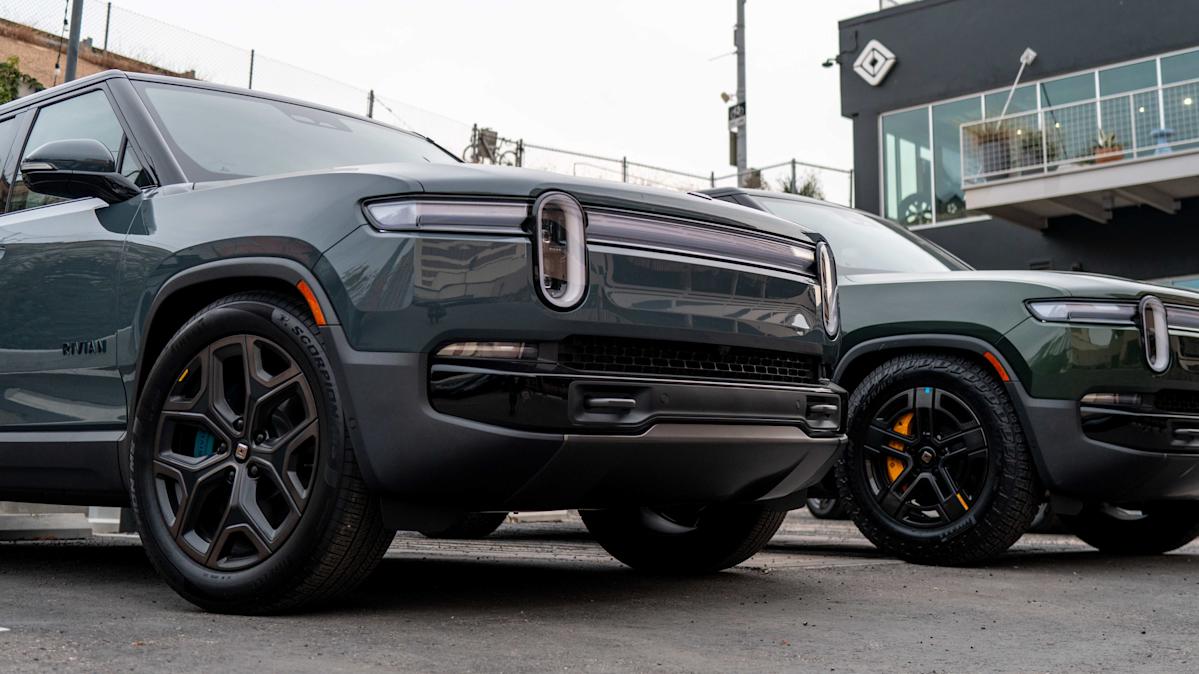
Rivian is actively producing and selling its larger R1T and R1S EVs alongside EDV delivery vehicles. The company announced that it produced 10,236 vehicles and delivered 10,365 vehicles in Q1. Rivian also reaffirmed its delivery guidance for 2026, estimating between 62,000 and 67,000 vehicles.
In the previous year, Rivian recorded a larger adjusted EBITDA loss of $2.063 billion, with capital expenditures reaching $1.71 billion.
Cash Position and Future Prospects
The company’s liquidity status remains a critical area of focus. Rivian ended the first quarter with $4.83 billion in cash and equivalents, and a total liquidity of $5.39 billion. This is down from $6.082 billion in cash at the end of Q4.
“With the support from Volkswagen, Uber, the DOE loan, and our existing cash, we have approximately $13.6 billion in accessible liquidity to support our ramp-up activities in the coming years,” Scaringe remarked.
In March, Rivian also struck a deal with Uber, allowing the rideshare company to invest $1.25 billion in exchange for up to 50,000 autonomous R2 EVs.
Conclusion
Rivian’s first quarter results reflect a strategic focus on production efficiency and capital management as it prepares for significant growth with the R2 SUV and expansion of its manufacturing capabilities. The adjustments to its funding commitments and ongoing partnerships position the company well for the ambitious targets ahead.