Nvidia (NVDA) is approaching a crucial juncture as it experiences a remarkable surge in its stock performance. Tom Hayes, the chair of Great Hill Capital, recently highlighted the significance of the $212 level, suggesting that if Nvidia can surpass this price, it may continue its upward trajectory in the coming weeks.
This $212 mark represents the peak intraday stock price Nvidia achieved on 27 October 2025. A break above this threshold could potentially attract more investors and fuel further momentum.
As of Thursday, Nvidia shares have risen by an impressive 21% in April, marking an extraordinary 11-day winning streak. Several factors contribute to this rally. Notably, Taiwan Semiconductor Manufacturing Company (TSMC) has reported thriving demand for artificial intelligence technology, affirming the bullish outlook for Nvidia. Given that TSMC produces the chips for Nvidia, robust demand in its sector could signal a highly successful financial quarter ahead for the company.
Moreover, Nvidia has maintained a steady stream of positive news, further bolstering investor confidence. Recently, the company announced a strategic expansion beyond its traditional graphics processing unit (GPU) business by introducing Ising, an open platform of quantum AI models that are already in utilisation at various labs and prestigious universities.
The broader stock market’s unexpected resilience this month, particularly with the S&P 500 up 11%, has also encouraged investment in high-growth stocks like Nvidia. The ongoing hopes for resolution in the US-Iran conflict have contributed to this uplifting market sentiment.
Despite this momentum, there are questions about how sustainable these gains may be. Jonathan Krinsky, a strategist at BTIG, noted that market strength often leads to further strength, although some consolidation may be in order. The recent turn in Nvidia’s stock performance marks a significant turnaround from a difficult first quarter.
During that quarter, Nvidia’s stock fell by 7.6%, underperforming compared to other major indices such as the S&P 500, Dow Jones Industrial Average, and Nasdaq Composite. The stock closed below the critical 200-day moving average, a concerning sign for investors when it dropped beneath this level in mid-March.
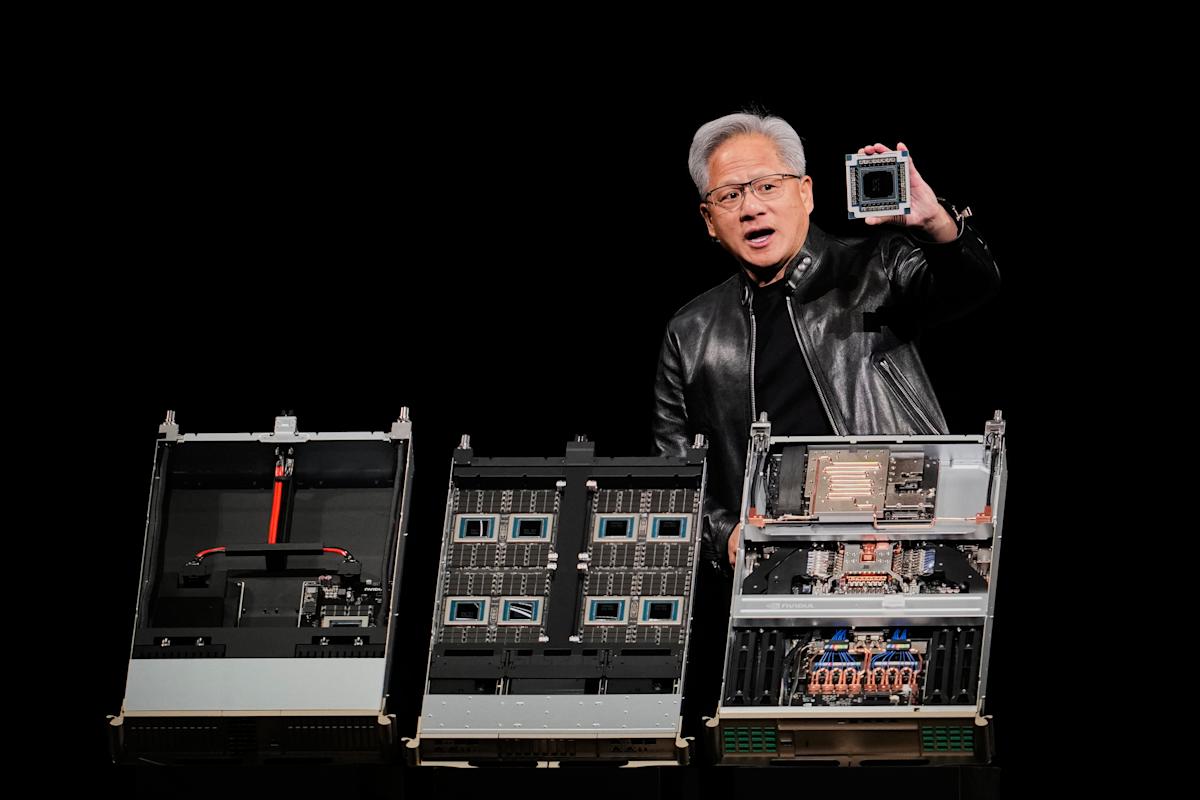
Despite a successful GTC 2026 event, where CEO Jensen Huang outlined an ambitious $1 trillion revenue pipeline extending through 2027, the market reacted negatively, prompting a “sell the news” sentiment among investors who were apprehensive about the extent of growth already reflected in Nvidia’s lofty valuation.
Additionally, there were broader concerns impacting investor sentiment, particularly regarding Nvidia’s capacity to monetise its dominance in the artificial intelligence training chip market amidst ongoing uncertainty about transitioning into AI inference – the practical implementation of AI models in production environments.
Overall, Nvidia is at a pivotal moment that could define its trajectory in the near future, shaped by both its performance in the AI sector and the evolving dynamics of the stock market.