Table of Contents
Gold (XAU/USD) is attempting a slight rebound from the $4,480 level, the lowest it has been since March 30, reached during the Asian trading hours on Monday. However, the potential for significant gains appears restrained as the US Dollar (USD) continues to maintain its strength amid ongoing geopolitical tensions. Heightened Crude Oil prices are raising concerns about inflation and are fuelling expectations of a more aggressive stance from the US Federal Reserve (Fed), further bolstering the USD and keeping pressure on the non-yielding metal.
Recent developments in the Middle East have contributed to this situation, with a drone strike igniting a fire at the Barakah Nuclear Power Plant in the United Arab Emirates (UAE). Additionally, Saudi Arabia reported intercepting three drones from Iraq and warned of operational measures to protect its sovereignty. US former President Donald Trump has also issued stern warnings to Iran, stating that action needs to be taken swiftly or the consequences will be dire. He insisted that “the clock is ticking,” indicating that delay may lead to disastrous outcomes.
This backdrop heightens the risk of a further escalation of tensions in the Middle East and dampens prospects for a US-Iran agreement, especially given the stalled peace talks, thus reinforcing the USD’s status as a reserve currency. The US blockade of Iranian ports and the near-closure of the Strait of Hormuz have pushed crude oil prices to a two-week peak, which in turn is increasing expectations of an interest rate hike by the US central bank in 2026. Currently, the CME Group’s FedWatch Tool suggests over a 50% likelihood that the Fed will raise borrowing costs by year-end. This outlook supports higher US Treasury yields, favouring USD strength and limiting further increases in gold prices.
Given the current situation, the trajectory for the XAU/USD pair appears to lead downwards. Any further price increases are likely to be met with selling pressure, especially in the absence of significant market-moving economic data from the US on Monday. Looking ahead, attention will shift to the FOMC Minutes scheduled for Wednesday, where traders hope to glean insights into the Fed’s forthcoming policy direction. This week also highlights the release of global flash PMIs, while ongoing geopolitical events could keep financial markets volatile, further driving demand for the USD and influencing gold prices.
Meanwhile, discounts on gold in India surged to unprecedented levels last week, although robust physical investment demand in China is keeping premiums over global benchmark prices stable. However, these factors may not sufficiently cushion gold prices, as escalating tensions, inflation fears, and a hawkish Fed stance are expected to continue supporting the USD.
XAU/USD Daily Chart
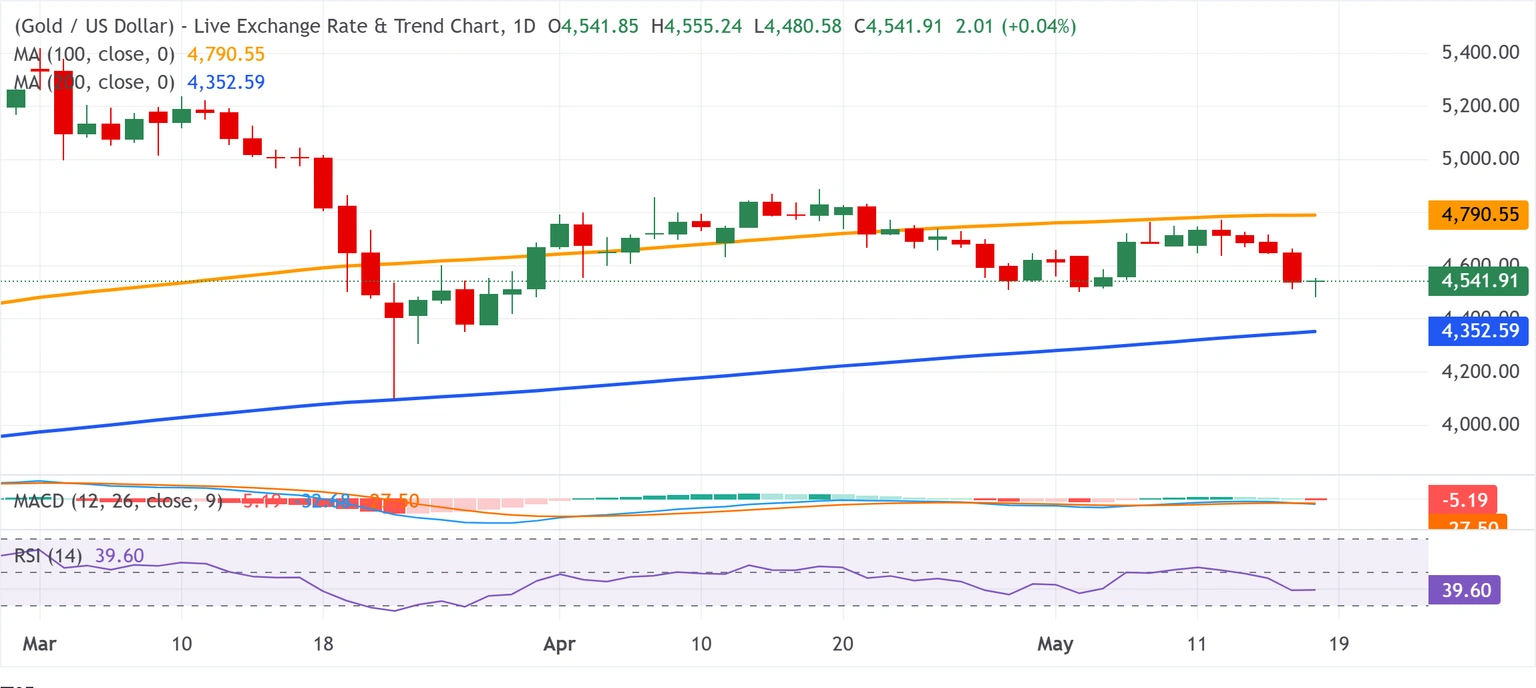
Gold Displays Resilience Below $4,500: Warning Signs Remain
The recent downturn, particularly after last week’s setback at the 100-day Simple Moving Average (SMA), suggests that a sustained presence below the psychological $4,500 barrier may indicate increasing downtrend momentum. The Relative Strength Index (RSI) hovers around 40, and a negative Moving Average Convergence Divergence (MACD) signal indicates prevailing subdued buying sentiment, reinforcing the near-term bearish outlook for gold.
Attention now shifts to the essential support region near the 200-day SMA, situated at $4,352.59. A decisive breach here could open the door to more profound corrective losses in the upcoming trading sessions. Conversely, the 100-day SMA at $4,790.55 presents the first critical resistance level that bulls would need to regain to alleviate current downward pressure.
(Technical analysis for this report was generated utilizing AI tools.)
Gold FAQs
Historically, gold has served as a vital store of value and means of exchange. Today, beyond its aesthetic appeal and use in jewellery, it is increasingly regarded as a safe-haven asset, particularly valued during periods of uncertainty. Gold is also perceived as a hedge against inflation and currency devaluation since it operates independently of any specific issuer or government.
Central banks are the largest holders of gold. In times of uncertainty, these institutions tend to diversify their reserves by acquiring gold, reinforcing the perceived robustness of their economy and currency. In 2022, central banks globally added 1,136 tonnes of gold, valued at approximately $70 billion, marking the highest annual acquisition on record. Nations like China, India, and Turkey are rapidly augmenting their gold reserves.
Gold typically exhibits an inverse correlation with the US Dollar and US Treasuries, both key reserve and safe-haven assets. A depreciation in the Dollar generally results in a rise in gold prices, allowing investors and central banks to diversify assets during turbulent times. Gold also tends to move inversely to risk assets; a stock market rally often diminishes gold prices, while market sell-offs tend to favour gold.
Gold prices can fluctuate due to various factors, such as geopolitical instability or recession fears, prompting spikes in gold prices due to its safe-haven status. As a non-yielding asset, gold typically rises in value when interest rates are low, while higher interest rates generally weigh down prices. Nonetheless, movements are largely influenced by the behaviour of the US Dollar (USD) since gold is priced in dollars (XAU/USD). A strong USD tends to suppress gold prices, while a weaker USD usually drives them higher.