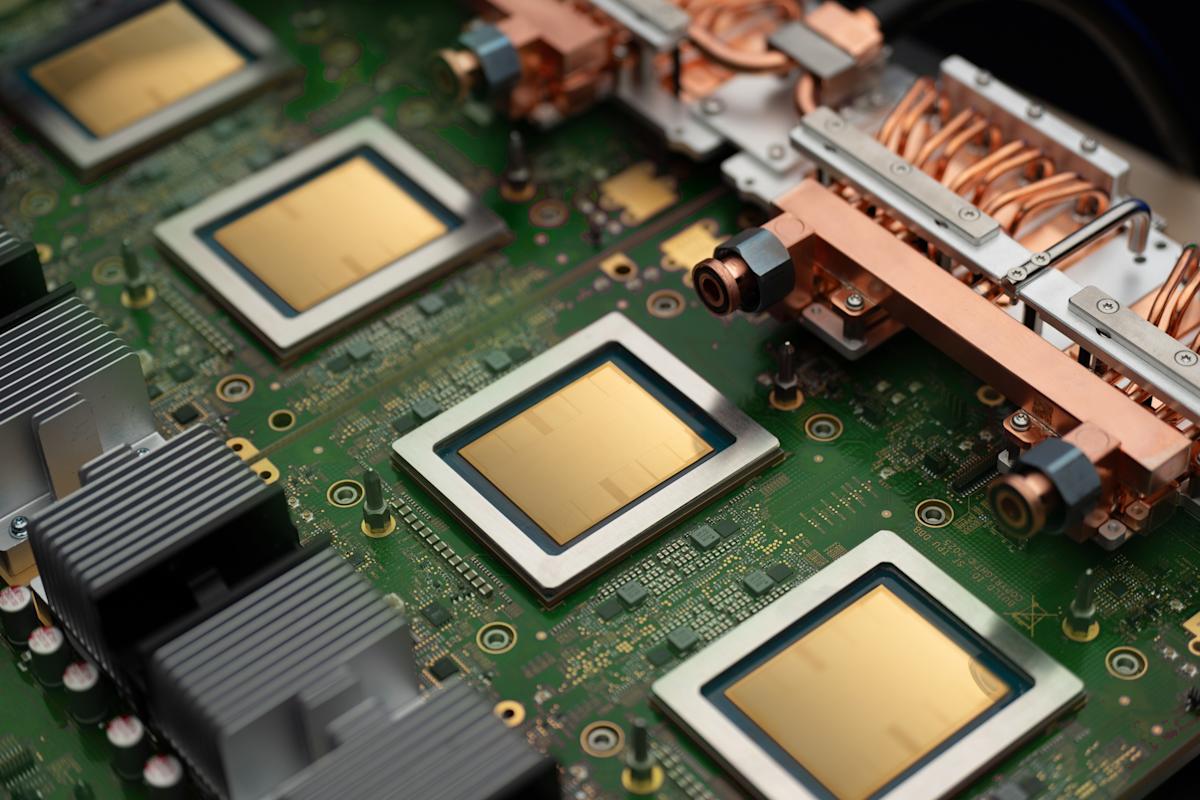
During the Google Cloud Next 2026 conference held in Las Vegas, Google (GOOG, GOOGL) unveiled two new AI processors, the TPU 8t and TPU 8i. These latest chips mark a significant step in Google’s competitive strategy against major players like Nvidia (NVDA) and AMD (AMD). Earlier in the month, Google expanded its partnership with Anthropic (ANTH.PVT) to deliver “multiple gigawatts of next-generation TPU capacity” to the AI research lab.
Moreover, Google is also planning to support OpenAI (OPAI.PVT) by providing TPU capacity for its AI initiatives. In a noteworthy development, The Information reported a recent multiyear, multibillion-dollar agreement between Google and Meta for access to its TPUs.
The TPU 8t is designed primarily for training AI models, aiming to significantly expedite the development process from months to mere weeks. Google asserts that the TPU 8t provides improved price-performance efficiency, being 2.8 times better than its previous model. This advancement is crucial for customers seeking powerful chips without exorbitant operational costs.

Conversely, the TPU 8i is optimised for inference tasks, including running AI models and managing AI agents. Both chips are scheduled for release later this year.
Tech giants like Google, Amazon (AMZN), Microsoft (MSFT), and large firms such as Meta (META) are increasingly stepping into the realm traditionally dominated by Nvidia and AMD. Both Amazon and Google have begun producing their own AI chips, which they provide to third-party partners.
Just recently, Amazon announced a significant chip agreement with Anthropic. This deal entails the AI laboratory investing over $100 billion in AWS technologies over the next decade. Additionally, Meta is in the development stages of its own AI processors, known as the Meta Inference and Training Accelerator (MTIA), aiming to rival Nvidia’s flagship products. Microsoft is similarly in the process of creating its own AI processors.
The growing involvement of Nvidia’s clients in developing their own chips raises potential challenges for Nvidia in the future. Recently, Nvidia disclosed that hyperscalers accounted for just over 50% of its data centre revenue. In the past fiscal quarter, the data centre segment was Nvidia’s most lucrative, generating $193.7 billion out of $215.9 billion in total sales for fiscal 2026, which concluded in January.
Despite the competitive landscape, Nvidia remains unfazed by claims that its clients’ chip developments pose a strategic threat, maintaining that its processors are adaptable and can cater to diverse workloads.
Summary
Google’s recent unveiling of the TPU 8t and TPU 8i at the Google Cloud Next 2026 conference signifies its aggressive push against competitors Nvidia and AMD in the AI chip market. The TPU 8t focuses on model training, while the TPU 8i is designed for inference. Both processors promise improved performance metrics and are set to be available later in the year. The competitive landscape is heating up as major tech companies like Amazon, Meta, and Microsoft develop their own AI chips, presenting new challenges for Nvidia, which generates a significant portion of its revenue from data centre sales.