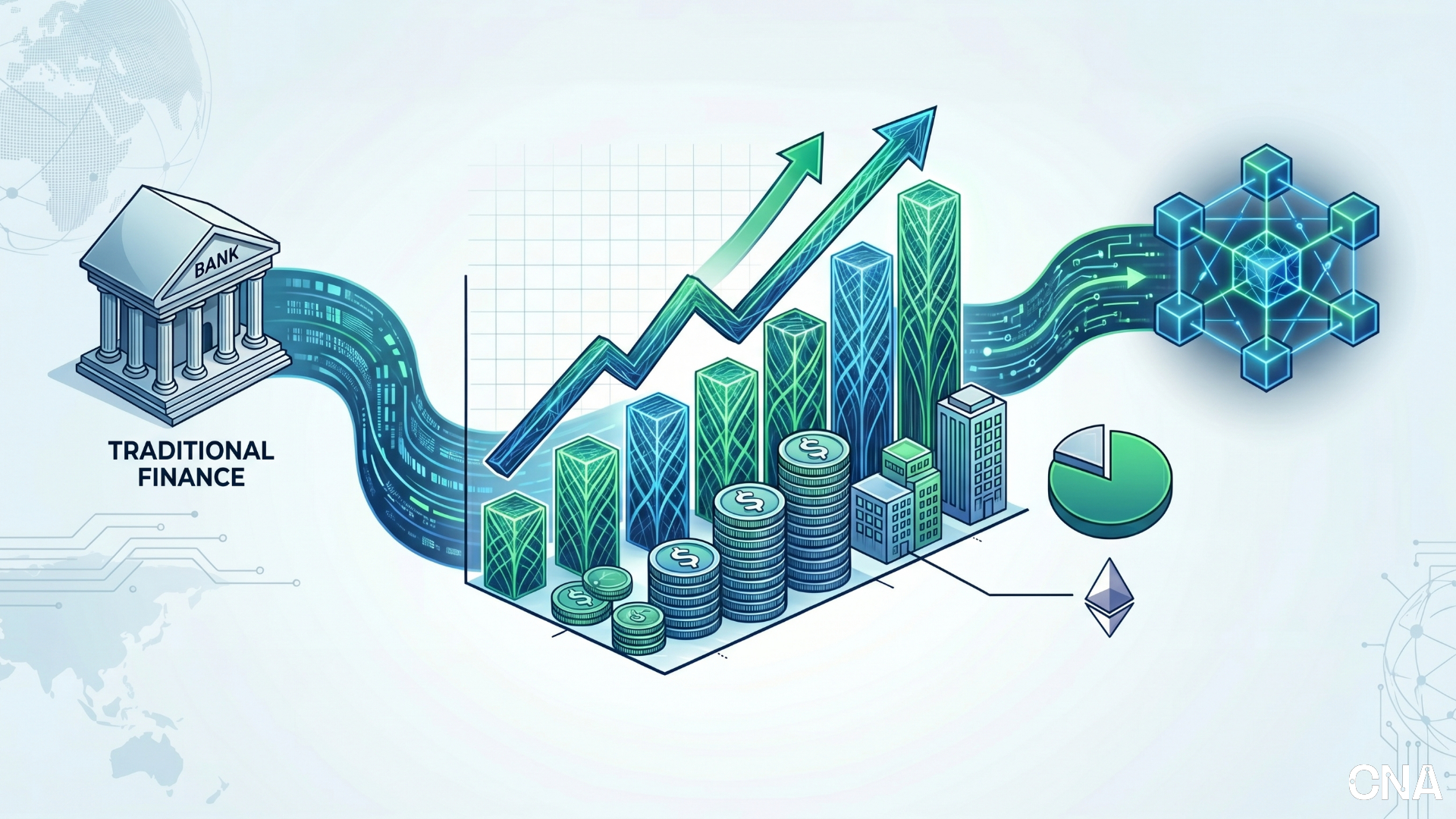
Surge in Tokenised Real-World Assets Signals Institutional Interest
Overview
The market for tokenised real-world assets has experienced significant growth, reaching approximately US$43 billion (AU$61.06 billion), a notable increase of around 37% in the past six months. This growth indicates a shift in traditional financial products towards blockchain networks, showcasing a unique trend driven by institutional interest that remains somewhat independent of fluctuating cryptocurrency prices.
Market Dynamics
According to data from Token Terminal, tokenised funds constitute nearly 80% of the overall market. Commodities account for 16.6%, while tokenised equities only represent 3.8%. This distribution highlights where institutions are focusing their investments: firstly on yield-bearing products and cash management solutions that closely align with existing financial instruments. In contrast, commodities and equities are still developing as the blockchain transition predominantly favours more conventional financial products.
Interestingly, the market size reported by RWA.xyz significantly varies, estimating a total below US$33 billion (AU$46.86 billion) due to differing methodologies in defining tokenised assets.
Ethereum’s Dominance
Ethereum (ETH) continues to dominate the tokenised asset landscape, holding 57.8% of total asset value. Other blockchains like BNB Chain, zkSync Era, XRP Ledger, and Stellar follow, but with significantly lower percentages: 8.5%, 7.5%, 5.8%, and 5.4% respectively.
Among issuers, Sky leads with approximately US$6.1 billion (AU$8.66 billion) in tokenised assets, significantly ahead of competitors Securitize and Ondo Finance, each managing around US$3.6 billion (AU$5.11 billion). The market remains largely concentrated within a few key players, indicative of limited retail participation.
Conclusion
The rapid growth of tokenised real-world assets signals not only the increasing adoption of blockchain technology in traditional finance but also points towards a future where institutional investment shapes the landscape of digital assets. Despite discrepancies in market valuations, the prevailing trends highlight Ethereum’s leading role and the importance of yield-generating financial products in attracting institutional investors. As the market continues to develop, the movement of other asset classes onto blockchain could reshape participation dynamics and broaden the scope of tokenised assets.