Table of Contents
Nvidia (NVDA) experienced a minor dip in its stock price during after-hours trading following a first-quarter earnings report that exceeded Wall Street predictions regarding earnings and revenue.
In addition to the financial results, Nvidia’s Chief Financial Officer, Colette Kress, shared four significant insights about the company’s operations, going beyond just the earnings per share performance.
Hyperscalers Drive Major Revenue Growth
Nvidia highlighted that hyperscaler clients, including Amazon (AMZN), Alphabet (GOOG, GOOGL), and Microsoft (MSFT), constitute approximately 50% of the company’s data centre revenue. Kress revealed that revenue from hyperscalers rose by 12% during the first quarter, reaching $38 billion. The other half of the revenue was derived from various sectors including AI clouds, industrial, enterprise, and sovereign customers.
Absence of Revenue from China
In a striking point, Nvidia reported no income from China in this quarter, contrasting with $4.6 billion generated from the region in the same quarter of the previous fiscal year. Although the U.S. government has permitted the export of H200 chips to Chinese clients, there is uncertainty about market acceptance due to discouragement from Chinese regulators aimed at bolstering the domestic chip industry.
Kress stated, “We have not generated any revenue from China, and we are unclear whether imports will be accepted in the future. As in the previous quarter, we are excluding any projected revenue from the Chinese data centre sector in our forecasts.”

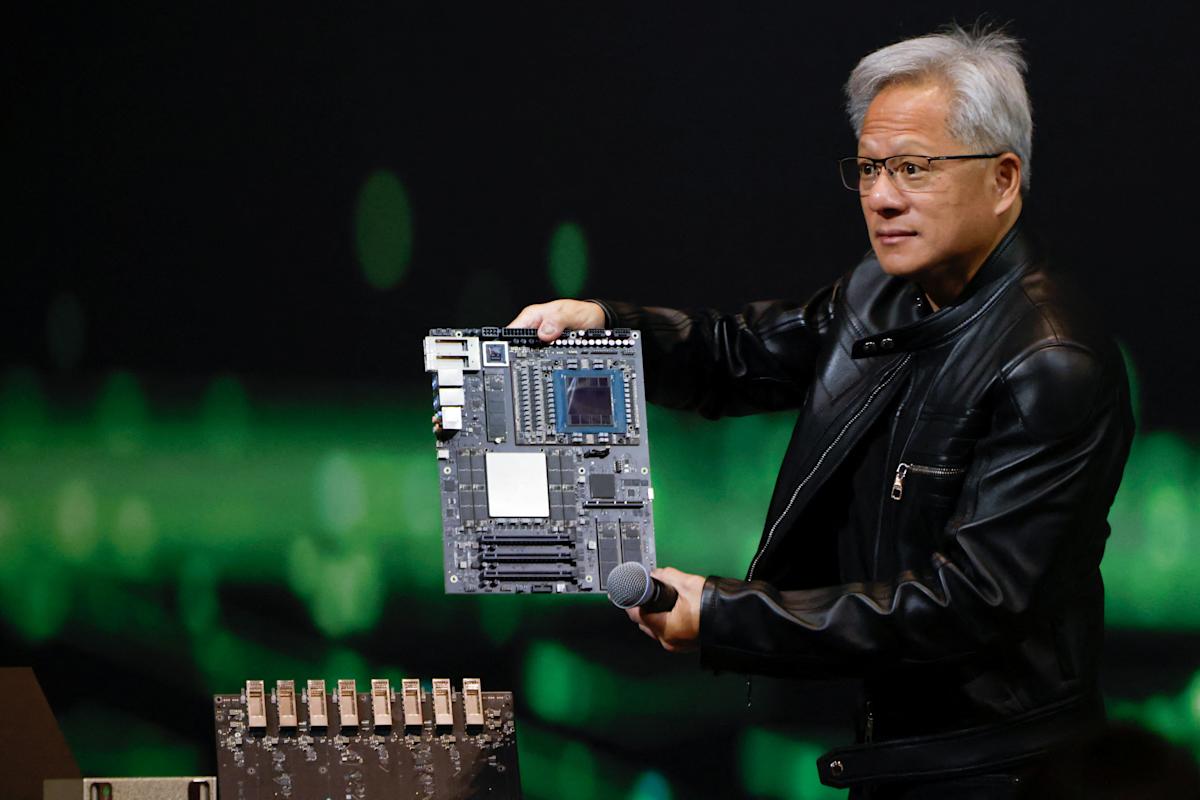
Nvidia founder and CEO, Jensen Huang, at the Milken Institute Global Conference in California on May 4, 2026. (Photo: Patrick T. Fallon / AFP via Getty Images)
New Earnings Reporting Framework
Nvidia is in the process of revising its earnings reporting structure, introducing two market categories: Data Centre and Edge Computing. The Data Centre segment will encompass operations from major technology firms as well as dedicated data centres, while Edge Computing will focus on data processing devices used in autonomous systems and physical AI, including personal computers, gaming consoles, and automotive technology.
This overhaul aims to provide investors with clearer insights into the company’s growth engines. Previously, Nvidia reported figures across multiple areas including Gaming, Professional Visualisation, and Automotive sectors. CEO Jensen Huang explained that the intention behind this change is to enhance investor understanding of Nvidia’s diverse AI and computing landscape.
Increased Returns for Investors
Lastly, Nvidia’s board has ratified a substantial increase to its quarterly dividend from $0.01 to $0.25 per share, in addition to an extensive $80 billion share buyback initiative. This move aligns Nvidia more closely with its Big Tech peers and is expected to appeal to a broader range of investors.
Reports indicate that investors sought a return boost, reflecting Nvidia’s strategy to allocate more capital back to shareholders while potentially reducing investments in other ventures. CFRA Research’s senior vice president, Angelo Zino, noted that this is an appealing prospect for investors, especially as Nvidia’s growth rates may eventually start to slow.
In summary, Nvidia’s recent developments reflect a solid financial performance, coupled with strategic moves aimed at enhancing shareholder value and adapting to market changes, particularly in its global operations and revenue reporting methods. Investors will be closely monitoring these shifts as the company continues to evolve within the dynamic tech landscape.