Tesla’s Q1 Earnings: A Mixed Bag of Caution and Optimism
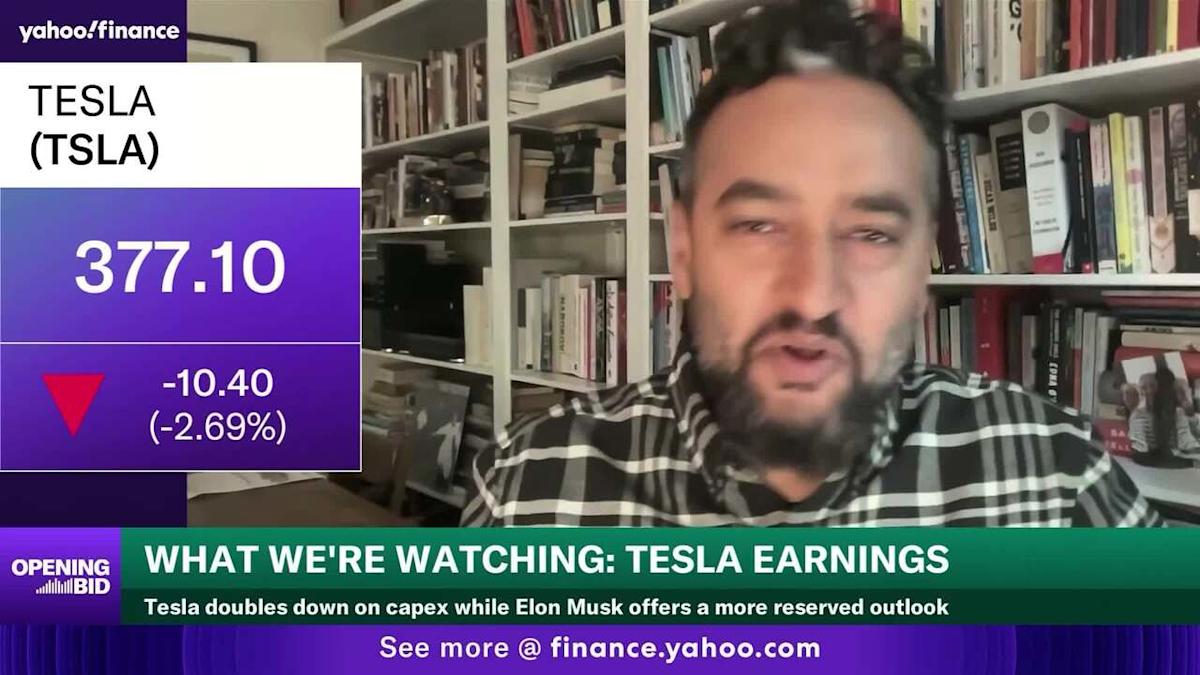
Despite a dip in Tesla’s (TSLA) stock following the release of its first quarter earnings report, analysts on Wall Street have expressed a cautious optimism about the company’s future prospects. The announcement of a substantial $25 billion capital expenditure (capex) plan came as a surprise, significantly exceeding market expectations.
Piper Sandler’s analyst, Alexander Potter, noted that while the stock would typically see an after-hours rise, the $5 billion capex increase for 2026 dampened that outcome. He pointed out that the previous capex forecast of $20 billion was already double the company’s prior peak, illustrating Tesla’s ambitious expansion plans. With Q1 capex recorded at only $2.49 billion, the revised guidance suggests a likelihood of negative free cash flow for 2026. Nonetheless, Potter highlighted that investments in artificial intelligence (AI), particularly in Full Self-Driving (FSD) software, are beginning to pay off, resulting in a notable increase in FSD subscriptions. He maintained an Overweight rating on the stock with a price target of $500.
Adding to this sentiment, Morgan Stanley’s Andrew Percoco acknowledged the elevated capex levels but emphasised that this short-term investment is crucial for long-term growth. Percoco remarked that Tesla’s broader strategy includes significant manufacturing expansion across energy, vehicles, and semiconductors, as well as investments in next-generation AI infrastructures, including robotaxis and humanoid robots. He reiterated his Equal Weight rating with a price target of $415. He also noted that the cautious rollout of the robotaxi programme is prudent, despite being slower than investor expectations; monitoring safety performance metrics against competitors such as Waymo will be critical.
William Blair’s Jed Dorsheimer adopted a similarly cautious stance, commending Tesla’s careful approach to the robotaxi project. He warned that any high-profile incidents could adversely affect the company’s progress and public perception. Dorsheimer also agreed with CEO Elon Musk’s decision to delay the release of the Optimus robot until production readiness is confirmed, highlighting the challenges involved in launching a new product line.
Expected to kick off shortly in Q2, preparations for Tesla’s large-scale Optimus factory signal a significant step forward. This facility is anticipated to yield up to 1 million robots annually, although such ambitious targets are a hallmark of Musk’s approach. Dorsheimer upheld his Market Perform rating for Tesla’s stock.
Conversely, Wedbush’s Dan Ives viewed the increase in capex as a positive development, asserting that it reflects Tesla’s commitment to advancing physical AI technologies, including unsupervised FSD and robotaxi services. Ives reported a jump in FSD paid subscriptions, rising to approximately 1.3 million globally, and indicated that the anticipated unsupervised FSD launch is expected in late 2026, with aggressive targets for revenue contributions set for 2027. He maintained an Outperform rating and a street-high price target of $600.
In summary, while Tesla’s recent earnings report has raised concerns about short-term cash flow issues due to increased capex, analysts have highlighted the company’s long-term commitment to innovation and leadership in autonomous vehicle technology. The market continues to watch these developments closely, acknowledging both the challenges and opportunities that lie ahead for Tesla.