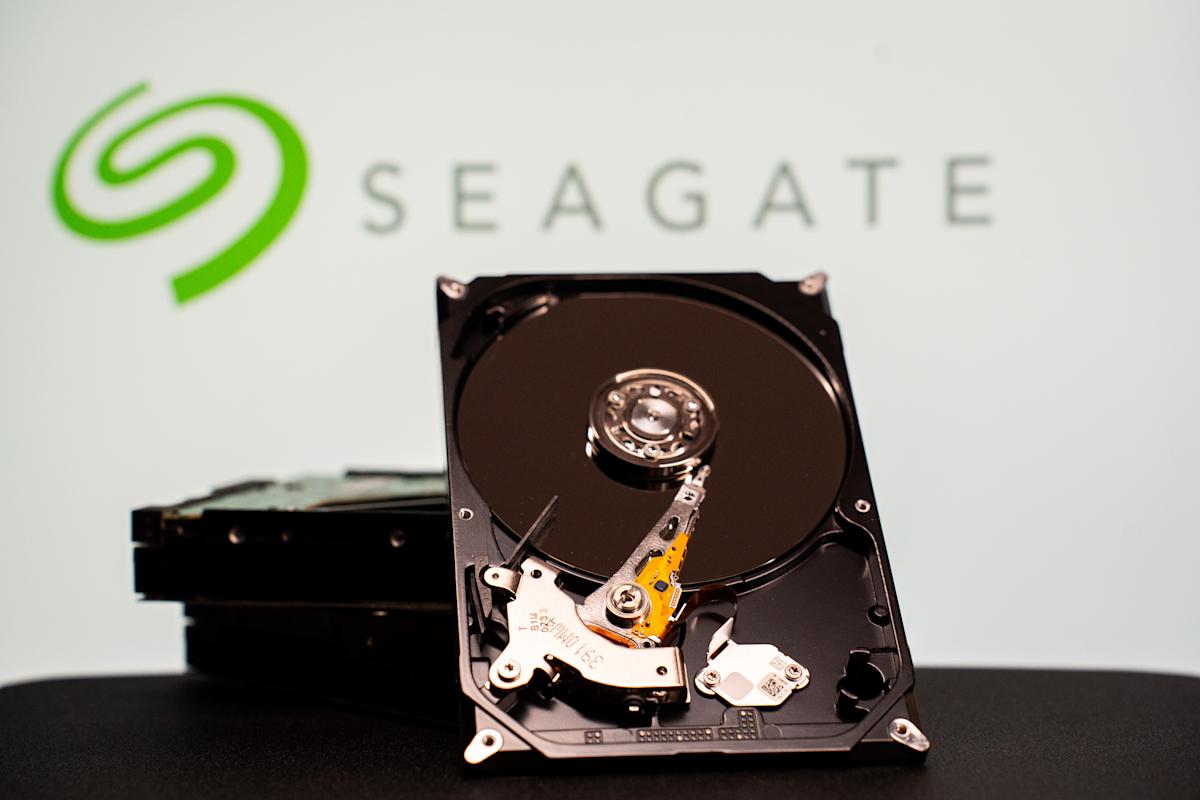
The AI surge is causing a significant storage shortage, which may enhance profits for key players such as Seagate Technology (STX) and Western Digital (WDC) for the foreseeable future.
According to a recent analysis by Bank of America’s expert, Wamsi Mohan, the supply of hard disk drives (HDDs) remains constrained, as manufacturers are not expanding their production capabilities. He views this situation as a fundamental shift in the market landscape. “Demand continues to outstrip supply, paving the way for original equipment manufacturers (OEMs) to hike their prices,” Mohan noted.
Both Seagate and Western Digital stand to gain from this trend, as data centres increasingly require high-capacity HDDs to store and manage vast AI datasets. While graphics processing units (GPUs), notably from Nvidia (NVDA), are essential for data processing, HDDs provide the most economical storage solution for the huge amounts of data driving large language models (LLMs). These drives play a crucial role for influential infrastructure providers like Amazon (AMZN), Microsoft (MSFT), and Google (GOOG, GOOGL).
The industry landscape has transformed into an “oligopoly,” according to Mohan, with only three dominant manufacturers. Toshiba, although not explicitly detailed in his report, is identified as the third key player. The low threat of new competitors entering the market empowers the remaining giants to wield substantial pricing authority amid escalating demand from technology firms.
Mohan projects that Seagate’s earnings could almost double, reaching $45 per share by 2028 in a bullish scenario. He has revised his stock price target for Seagate to $700, applying a 29x multiple based on his 2027 earnings predictions. Simultaneously, he anticipates that Western Digital’s earnings could hit $33 per share, setting a target price of $495 under similar aggressive estimations.
Investor sentiment is already shifting, with Seagate’s stock skyrocketing by nearly 600% over the past year and Western Digital’s shares soaring approximately 850%.
Both companies are showing robust performance. Seagate reported annual revenue of $9.10 billion for fiscal 2025, marking a 39% increase year-over-year. In its latest quarterly reveal on April 28, it achieved revenue of $3.11 billion, a remarkable 44% rise compared to the previous year, surpassing analysts’ expectations of $2.95 billion; adjusted earnings per share (EPS) stood at $4.10, exceeding forecasts of $3.50.
Western Digital’s performance also strengthens its position, with fiscal 2025 revenue reaching $9.52 billion, indicating a 51% year-over-year growth. The company reported revenue of $3.02 billion in its most recent second quarter, surpassing Wall Street’s expectations of $2.98 billion with a 25% jump; its adjusted EPS was $2.13, beating projections of $1.95. The company will announce its third quarter earnings on April 30.
Mohan highlights several factors contributing to the favourable outlook for these storage giants. Both Seagate and Western Digital are increasingly securing long-term contracts, providing them with better revenue visibility. This change in business strategy shifts from unpredictable hardware sales toward a more stable model characterised by recurring demand.
Another technological advancement, heat-assisted magnetic recording (HAMR), is enhancing the efficiency of HDDs by allowing more data storage in the same physical size. This innovation reduces material costs as companies can increase storage density without needing more hardware components.
However, caution remains prudent. High prices tend to attract competition. Moreover, should the hype around AI wane, the demand for substantial data storage may diminish as well. Mohan points out potential downside risks, including a sudden drop in cloud expenditure from tech giants, delays in the rollout of HAMR technology, or a resurgence of conventional price wars.
In conclusion, as the demand for data storage surges alongside AI advancements, Seagate and Western Digital are uniquely positioned to leverage their market position, potentially leading to significant profit growth in the years to come.